
For a successful transition of your dog off kibble to homemade cooked food, you need a plan.
You will hear about balance diets and ratios and such. And yes, while there’s planning work to be done to ensure you are doing the right thing, afterwards you just have to execute the plan. Also, sure your dog’s diet has to be balanced, but that doesn’t mean 100% perfection every single meal. Remember, it’s a marathon not a sprint. You just need to make sure you are in the vicinity of being somewhat balanced, no need for it to be perfect.
Here’s what I assembled around a plan for my own journey to feed Goose homemade food. It’s not the only way, the perfect way or the easy way. It’s the way that worked for me, but you need to make your own decisions. Hope this helps you. Note this is for a dog generally in good health and not for young puppies.
For context, This is Goose. He is an 11 month old Golden Retriever, currently at 33kg (as of 6 March 2024).

I started Goose on home cooked food when he was 8 months old. Most of his growing was done and his growth spurt was plateauing . He was 33kg already at 8 months and the vet said I had to put the brakes on his weight gain because he was getting too heavy.
This was Goose’s weight at 8 months compared to the normal weight.
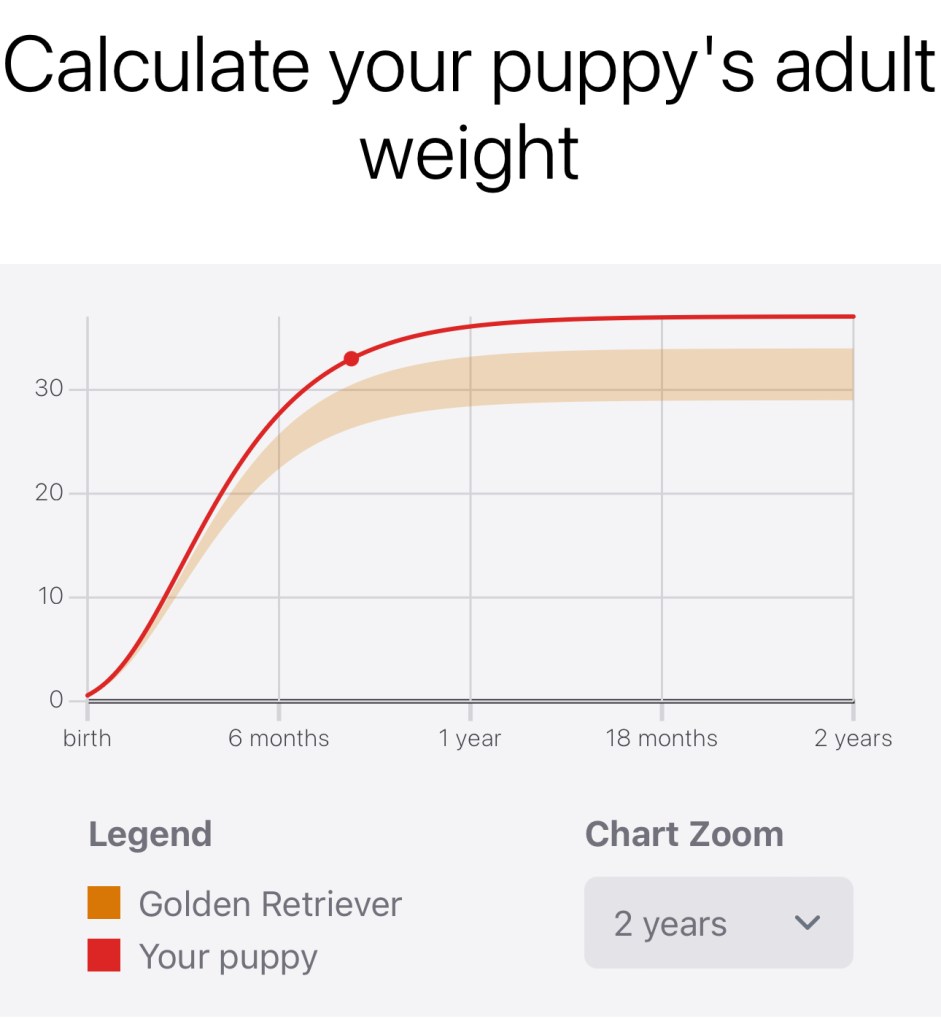
By creating and sticking to this plan, I’ve been able to keep him at 33kg since then and now this is what his weight chart at 11 months looks like:
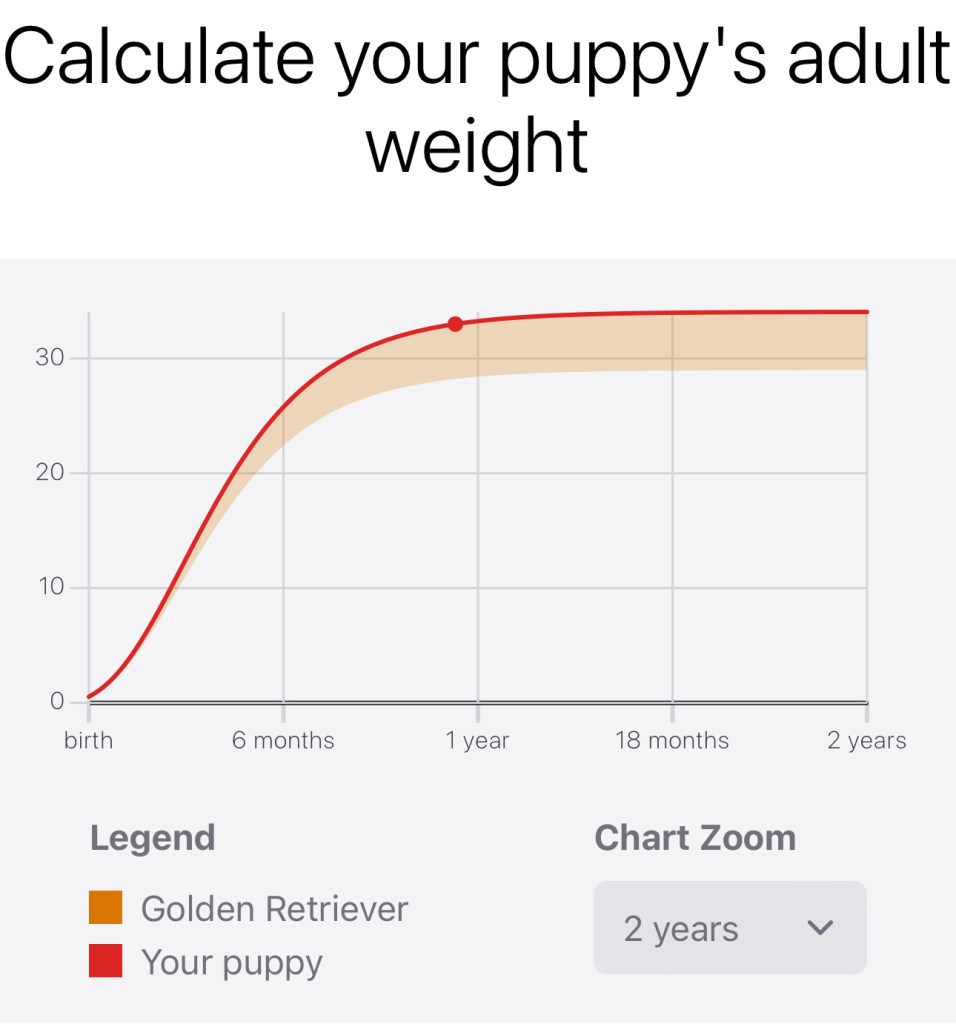
I’ve been able to get his weight in control while he still continues to grow lengthwise.
The plan.
1. how much to feed your dog
Guideline is to feed your adult dog 2% to 3% of its ideal body weight. For puppies, especially those less than 6 months old, they will need more , probably 4% to 6%.
If you want to use a toppers to freshen up your dog’s bowl, then you might drop this to 2% only of body weight for example (see Keep it Simple below).
If you want your dog to lose weight, you would choose the lower ratio of 2%. If you want them to gain weight, then you would choose the higher ratio of 3% or more even.
2. what food groups to consider
Dogs need meat, organs, bone, plant matter in their diets. General guidelines for ratios of these are :
- 80% meat (maximum amount)
- 5% liver (maximum amount)
- 5% other secreting organ like kidney (maximum amount)
- 10% veg/grain
Notes:
– while this might sound overwhelming, for an adult dog, you only need to do these calculations once and that’s it. You just use it over and over again. You don’t have to be forever weighing either. Measurements can be approximates everytime you cook. These calculations you do up front are just to give you an indication that you need 10lb of something for example and not 100lb.
– there is no bone here because bones or the nutrition from bones need to be provided outside the cooked meal because bones cannot be given to your dog if they are cooked. Hence you need to give your dog a supplement such as bone meal to compensate. Or you need to reduce the total amount you cook to 90% and feed raw bone as the 10%.
– if you are hybrid feeding – that is, feeding your dog a cooked meal, then feeding them raw bones separately of the cooked meal, you need to adjust your ratios to compensate.
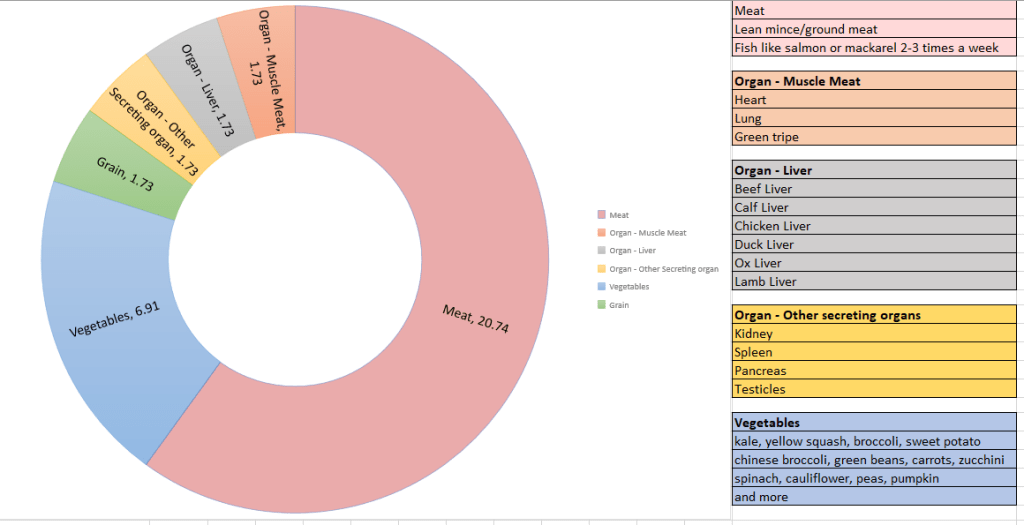
– the ratios are just a guide and you need to consider what is best for your dog. The meat ratio is quite high because dogs need a lot of protein. However, too much protein can cause kidney issues, gut issues and weight gain. Therefore, I choose to use a lower ratio because the veggies and other toppers I plan to use also have protein, and some meats are higher than others in their protein count. My dog is also a little chunky so I want to manage his weight and maintain and even lower it. Hence the ratios I choose are:
- 60% meat
- 5% heart (which is an organ but considered muscle meat)
- 5% liver
- 5% other secreting organ like kidney
- 15% veg
- 5% grain
– you need to fit in fish and eggs at least twice a week.
– there’s a lot of debate about grain. People say their species don’t need grain. However, I like to use grain because of the fibre it brings, and choose to use lower fat grain like quinoa, oats and wild rice. You need to decide how you feel about grain. Don’t use it. Use it. It’s up to you.
3. Dealing with organ ick factor.
Let’s face it. Handling organs is definitely not the highlight of a lot of people’s day. Personally, I just can’t touch it. Here are some suggestions:
- work out what you need for each batch of cooking and ask your butcher to mince your organ needs together already in the amounts you need. Then you can just dump it in at cooking time. Here is what my butcher dues for me.
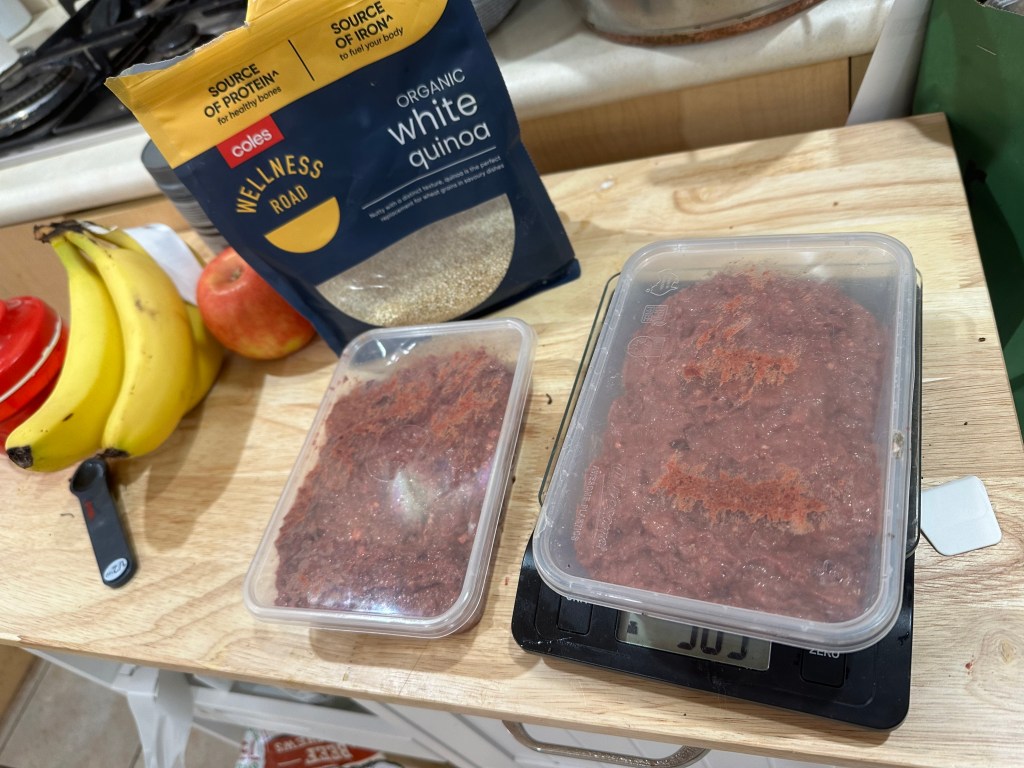
- freeze organs first before using. makes it easier to slice and more importantly, doesn’t make it splatter everywhere if you use a food processor (this is from first hand experience)
- use organ powders instead, so omit them from your calculations above. I am able to get organ powders in Australia from https://rawpawz.com.au/collections/organic-organ-powders.
You can read and learn more about organs from https://www.rawpetsrule.com/organs.html
4. supplements to consider
Unfortunately, try as we might, we will not be able to meet all our dog’s needs on cooked food alone. They will need supplements.
Supplements to consider are :
- replacement for bone (eg crushed egg shells – which replaces the calcium component only of bones, bone meal powder)
- gut health (eg probiotics like kefir or yoghurt or cottage cheese)
- thyroid/metabolism (eg seaweed powder)
- skin/coat health (eg salmon oil, coconut oil)
- immunity (eg hemp seed oil, olive oil, coconut oil, salmon oil)
- joint health (eg glucosamine, green lipped mussel powder)
- overall health / cancer fighting (eg spirulina)
Notes
– you don’t need all of these. The minimum in my view are the replacement for bone, gut health and thyroid. The rest would be dependent on your dog. For example, I have a golden retriever who are known to develop joint/hip issues and cancer. So for him, the supplements I use are
- replacement for bone – crushed egg shells
- gut health – kefir
- thyroid/metabolism – seaweed powder
- skin/coat health – salmon oil or hempseed oil (rotating)
- immunity – salmon oil or hempseed oil (rotating)
- joint health – green lipped mussel powder
- overall health / cancer fighting (eg spirulina)
5. rotation, rotation, rotation
Rotating meat and veg is important so that your dog doesn’t get bored , develop an intolerance by eating the same thing over and over again, and also to give your dog the opportunity to get nutrients in many varied ways.
6. keep it simple
If you are cooking a big batch of food, keep it simple. Think of it as the new kibble (only way healthier), where it is the base meal, then you can get creative on top with toppers. Note that if you do use toppers in this way, I would recommend to reduce the amount you feed as a base meal so that you don’t overshoot their daily intake requirements and end up with a chunky dog (oops). I put toppers on top of my base meal (like blueberries, oysters, sardines, banana, apple, etc), so I choose to feed my dog only 2% of his ideal weight instead of 3% (from step 1 above).
I use only 1 meat mainly in my cooked meal (sometimes 2) , and only 3-4 veggies. This way, everytime I change the meal, I can achieve the rotation needed as mentioned above.
7. mind your combinations
When choosing veggies in particular, try not to overload the meal with similar veggies. For example, carrot, spinach, pumpkin and zucchini are all high in Vitamin A. If you then also use liver (also high in Vitamin A), there’s a lot of Vitamin A there in one meal. Or sweet potato and potato are both high in carbs, try not to use them together.
My favourite combos are:
- Kale, broccoli, yellow squash and sweet potato
- Spinach, green beans, carrots, shiitake mushrooms
- Zucchini, pumpkin, rocket, cauliflower
8. walk first before you run
If your dog is still on kibble, I suggest you transition your dog slowly to cooked food. You can be extremely careful and introduce ingredients one at a time as toppers. Or you can cook a small batch of food and put that on top. The reason to go slow is to watch for any allergic reactions or intolerances. However you choose, I recommend not introducing anything new at night. You don’t want to deal with exploding diarrhea and vomit at 1am.
Bottom line is if your dog has come this far on kibble, why rush it. Invest the time now to avoid as much as possible on issues later.
9. watch your dog’s reactions
Make a start, have a go with these basics. Watch your dog, his weight, energy levels, and his poop.
Adjust your plan accordingly depending on what you observe. For example, if your dog is losing weight, then either feed him more or up the protein (if you are not at 80%). If your dog has no energy, maybe you need a little bit more carbs in his diet. If his poop is squishy, maybe some more fibre or some change your probiotics. It’s all trial and error until you find that best balance for your dog specifically.
10. phasing out kibble
If you slowly transition your dog, I would remove the same amount of kibble as what you add. That is , if adding 1/2 cup of cooked food, remove 1/2 cup of kibble.
I kept my dog on 50% kibble, 50% food until I was satisfied I had it under control. His kibble bag is almost finished, so I am not going to get another one.
11. risk vs reward with little puppies
People ask me what I fed my Goose before 8 months. I’m a first time dog mum. As such I was not (and tbh still am not) comfortable giving my Goose homemade food until his major growing was done. As you can see there’s so many things to consider when feeding your dog. Imagine having to get that right for a dog still growing? And you have to get it more right than for an adult dog , because anything could affect their growth. I was picturing him growing into a teeny tiny body but really big head. 😂 My view is the risk was not worth the reward.
So what I did instead was use that time to slowly introduce him to human food. Get him tasting a bit of chicken here , a bit of broccoli there…. One but one, little by little. I hand fed it to him so he thought of it a treat (and so wouldn’t start demanding it at mealtime ). That way he got used to it, I could watch for intolerance / allergy and I could learn what he likes ( which was not necessary because basically he loves everything).
I kept him on the kibble the groomer started him on, because I didn’t want to introduce him to something new at the same time as he was also getting used to his new life. I just thought that it would be good for him to have something familiar .
Then at 8 months I just started cooking together the things I previously introduced him with. And here we are.
12. The result for Goose….
This is what my final plan looks like (amounts in oz per day)
 Gourmet Goose
Leave a comment